
Roteiro econômico para quem quer luxo com preço de lanche
Dream trip with a real budget: the guide to the economic itinerary in 2026
An economic itinerary doesn’t mean giving up incredible experiences. It means being smarter about where and how you spend.
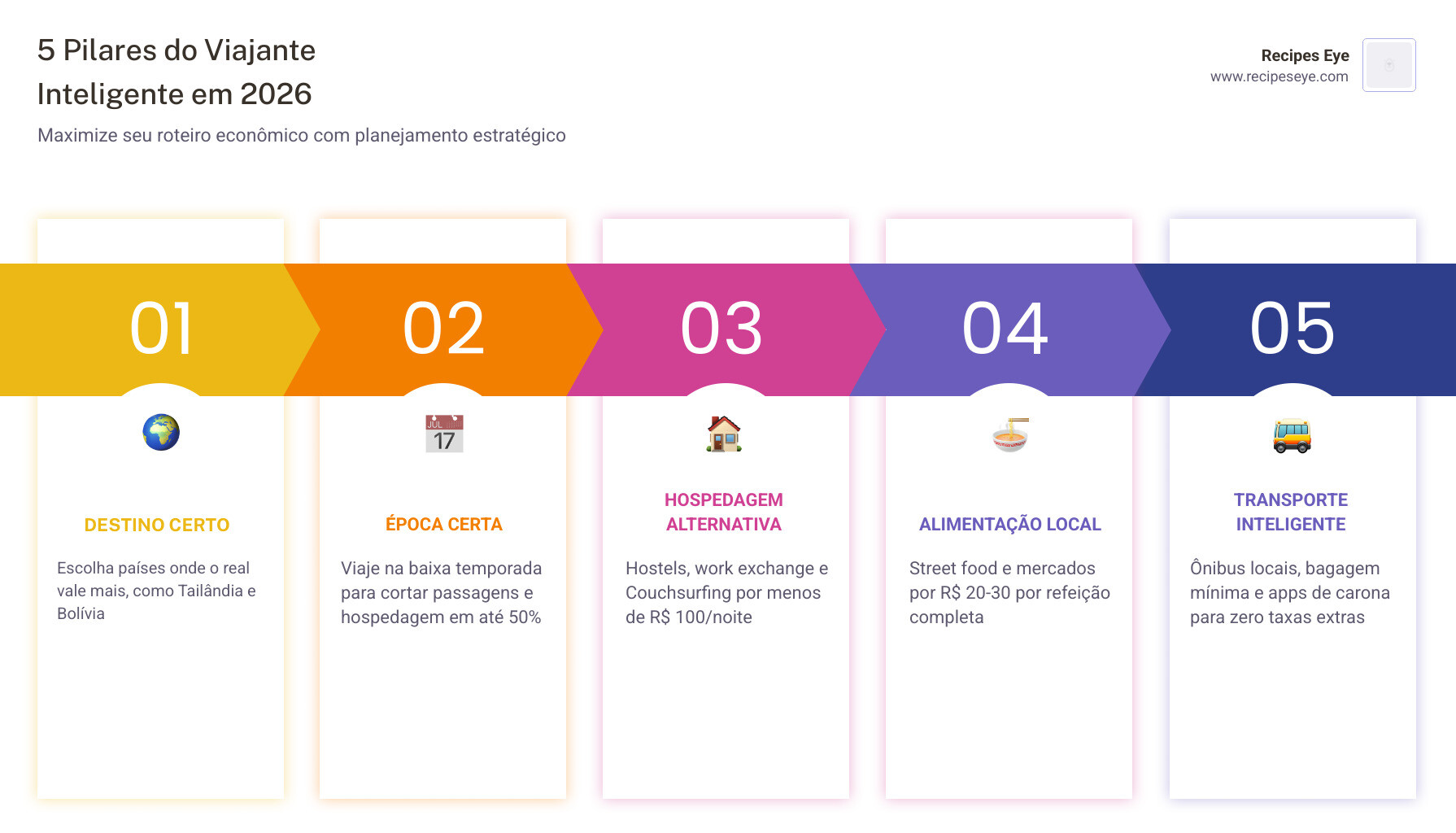
Quick answer: The best economic itineraries in 2026 combine these elements:
- Right destination – countries where the Real has more purchasing power (Thailand, Bolivia, Vietnam, Indonesia)
- Right time – traveling in the low season significantly reduces airfare and accommodation costs
- Alternative accommodation – hostels, work exchange, and Couchsurfing instead of expensive hotels
- Local food – street food and public markets instead of tourist restaurants
- Smart transport – public transport, minimal luggage, and no checked bag fees
To give you a concrete idea: in Thailand, it is possible to cover food, accommodation, and even a tour for less than R$ 300 per day. In Indonesia, a meal at a popular restaurant costs an average of US$ 1.79.
Sounds too good to be true? It’s not. In 2026, there are at least 26 countries considered cheap for Brazilians to travel to — and most people don’t even know half of them.
The real problem isn’t a lack of money. It’s a lack of a plan.
This guide shows, in a direct way, which destinations offer the best value for money, how to build your itinerary step by step, and where to cut costs without cutting the experience.
What defines a successful economic itinerary in 2026?
In April 2026, the concept of traveling cheap has evolved. We are no longer just talking about rustic backpacking, but about strategic planning that allows for so-called “affordable luxury.” The secret lies in the cost-benefit ratio: finding places where your money goes twice or three times as far as it would at home.
To understand how to build this plan, we need to look at the Macroeconomic scenario April 2026: Brazil and world analysis. Currently, the global economy shows signs of moderation, but Brazil shows resilience. With the effectiveness of the Selic rate transmission, which projects gradual cuts to reach 12% by the end of the year, the Brazilian investor and traveler gain a bit more predictability.
A successful economic itinerary depends on three pillars:
- Low season: Avoiding school holiday months and national holidays can reduce accommodation costs by up to 50%. Additionally, you avoid crowds, making the experience much more exclusive.
- Date flexibility: Using tools that compare prices on monthly calendars is essential. Sometimes, traveling on a Tuesday instead of a Saturday saves the cost of three hotel nights.
- Devalued currencies: The focus should be on countries where the local currency has depreciated against the Real or where the cost of living is naturally very low.
Daily Expense Comparison (2026 Estimates)
| Destination | Economic Meal | Accommodation (3 stars) | Water (1.5L) | Taxi (per km) |
|---|---|---|---|---|
| Thailand | R$ 16.50 | R$ 155.00 | R$ 2.85 | R$ 6.60 |
| Bolivia | R$ 14.90 | R$ 120.00 | R$ 3.60 | R$ 2.30 |
| Egypt | R$ 22.00 | R$ 160.00 | R$ 3.80 | R$ 1.80 |
International destinations where your Real goes further
Exploring the world without emptying your bank account requires looking beyond obvious destinations like Paris or New York. According to the Overview of the conjuncture | Conjuncture Letter, the growth of family income and the stability of the Brazilian labor market allow more people to plan international trips, provided they choose the right commercial partners and destinations.
Southeast Asia remains the “holy grail” of the economic itinerary. Countries like Thailand, Vietnam, and Indonesia offer paradise beaches and high-standard hotels for the price of simple guesthouses in Brazil. In Indonesia, for example, it is possible to find meals for less than US$ 2 in local markets.
In our neighbor South America, Bolivia, Peru, and Colombia dominate the list. Peru, in particular, combines one of the best cuisines in the world with very affordable transport and tour costs. Bolivia is undoubtedly the cheapest destination on the continent, ideal for those who want to see surreal landscapes like the Salar de Uyuni on a budget.
If your desire is Africa or Europe, Egypt and Morocco are unbeatable options. In Eastern Europe, Romania and Albania (considered the “Maldives of Europe”) offer medieval castles and crystal-clear waters without the exorbitant prices of the Western Euro.

Thailand and Vietnam: The pinnacle of the economic itinerary in Asia
Thailand is the darling of digital nomads for a reason: first-world structure with developing-country prices. In cities like Chiang Mai, the cost of living is so low that many Brazilians choose to spend months there. Bangkok offers majestic Buddhist temples and luxurious malls, while the islands, like the Phi Phi Islands, deliver movie-like scenery.
Vietnam is not far behind. In Hanoi, it is possible to find clean and well-located hostels for just R$ 26 a night. Vietnamese street food is world-famous and extremely cheap. A full dinner with a drink rarely exceeds R$ 30 at popular stalls.
Peru and Bolivia: A surprising and nearby economic itinerary
For those who don’t want to cross the ocean, the Peru-Bolivia axis is the logical choice. In Cusco, the gateway to Machu Picchu, the range of accommodation is vast. It is possible to stay in highly-rated 3-star hotels for about R$ 300 a night for a couple, including breakfast.
In Bolivia, the experience is even cheaper. La Paz, the highest administrative capital in the world, has a cable car system that works as public transport and offers incredible views for a few bolivianos. The Salar de Uyuni, although requiring a hired tour, offers one of the best returns on investment in terms of “memories per Real spent.”
Strategies to save on accommodation and transport
For your economic itinerary to work, you need to think outside the box of traditional hotels. In 2026, sharing economy platforms are safer and more professional than ever.
- Work Exchange: Platforms connect travelers to hosts who offer accommodation (and sometimes food) in exchange for a few hours of work. It could be on an organic farm, a hostel, or a social project. It is the ultimate way to travel “for free.”
- Couchsurfing: For the more social, sleeping on a local’s sofa is not just about saving money; it’s pure cultural immersion.
- Boutique Hostels: Forget those dirty, noisy rooms. Modern hostels offer privacy “pods” (capsules), modern design, and equipped shared kitchens, perfect for those who want to save by preparing their own meals.

Regarding transport, the golden rule is: travel light. In 2026, airlines are increasingly strict with checked bag fees. Traveling with only a carry-on backpack can save up to R$ 400 on an international flight. Additionally, it makes it easier to use public transport (bus and subway) instead of expensive taxis.
Don’t forget travel insurance. It may seem like an extra expense, but in countries with expensive healthcare systems or exotic destinations, a medical emergency without insurance can bankrupt any plan. Check if your credit card already offers this benefit for free.
Smart eating: From street food to gourmet lunchboxes
Here at Recipes Eye, we believe that eating well is a fundamental part of any trip. However, eating at tourist restaurants every day is the number one mistake that destroys an economic itinerary.
The smart strategy is to follow the flow of the locals. Public markets and street fairs are not just places to save money, but where the most authentic food is served. In Morocco, for example, outdoor food courts offer delicious tajines for a fraction of the price of hotels.
If you are staying in a place with a kitchen, take the opportunity to prepare your own meals. You can check more information about healthy recipes on our website for inspiration. Using seasonal ingredients bought at the local market ensures freshness and savings.
Interestingly, many of the “poor man’s recipes” of the past, created in times of scarcity, are today considered luxury delicacies. Brazilian Feijoada, Italian Pizza Margherita, and French Ratatouille were born from the need to use what was available. Learning to cook with simplicity is a valuable skill for the budget traveler. If you have access to an Air Fryer in your accommodation — something increasingly common in vacation rentals — the possibilities for quick and cheap meals are endless.
Frequently Asked Questions about economic itineraries
Which is the cheapest country to travel to in 2026?
Indonesia and India compete for the top of the list. In Indonesia, especially outside the main axis of Bali (such as in Java or Sumatra), the cost of living is very low. In India, it is possible to find comfortable hotel rooms for US$ 30 and full meals for less than R$ 10. In South America, Bolivia remains unbeatable, with meals in popular restaurants costing around US$ 2.89.
How to use AI to build a personalized economic itinerary?
In 2026, Artificial Intelligence tools like Layla AI have revolutionized planning. You enter your total budget, travel style, and dates, and the AI compares prices for flights, hotels, and activities in real-time. It optimizes routes to avoid unnecessary transport costs and suggests free attractions based on your profile. It’s like having a 24/7 travel agent in your pocket.
Is it safe to eat street food on budget trips?
Yes, as long as you use common sense. Street food is the soul of an economic itinerary. Observe where the locals are eating; a long line is a sign of high turnover and fresh ingredients. Avoid non-bottled water and prefer foods that are cooked or fried on the spot, right in front of you. It is the cheapest and most authentic way to get to know the local culture.
Conclusion
Traveling with an economic itinerary in 2026 is an art that combines technology, flexibility, and a dash of detachment. By choosing destinations where the Real is strong, such as Vietnam or Bolivia, and adopting smart consumption habits, you transform what would be a short and expensive trip into an epic and lasting journey.
The secret is not to spend little, but to spend well. Prioritize experiences and memories over shopping and souvenirs. The financial sustainability of your trip ensures that you can plan the next one as soon as you land.
We at Recipes Eye hope this guide helps you get your dreams off the paper. Simplicity at the table and on the road often reveals life’s greatest gems. Discover nutritious recipes for your next trip and start planning your adventure today!

