
Why Making Homemade Energy Bars Is Worth Every Minute
Homemade energy bars are one of the simplest and smartest ways to have a nutritious snack always at hand.
Quick answer — how to make homemade energy bars:
- Mix the dry ingredients: oats, seeds, dried fruits, and spices
- Heat the liquid ingredients: honey, peanut butter, or olive oil
- Combine the dry and wet ingredients in a bowl
- Press the mixture into a pan lined with parchment paper (about 3 cm thick)
- Bake at 180-190°C for 15 to 25 minutes, or refrigerate for 2 hours (no-bake method)
- Cut into bars after cooling completely
- Store in an airtight container for up to one week
Unlike industrial versions, homemade bars have no preservatives, excess sugar, or unnecessary saturated fats. And the best part: you choose every ingredient.
A homemade serving can have about 164 kcal, with 20.6 g of carbohydrates, 4.7 g of protein, and 2.2 g of fiber — real energy, with no mysterious ingredients on the list.
The preparation time can be as short as 10 to 15 minutes. That’s less time than a trip to the supermarket.
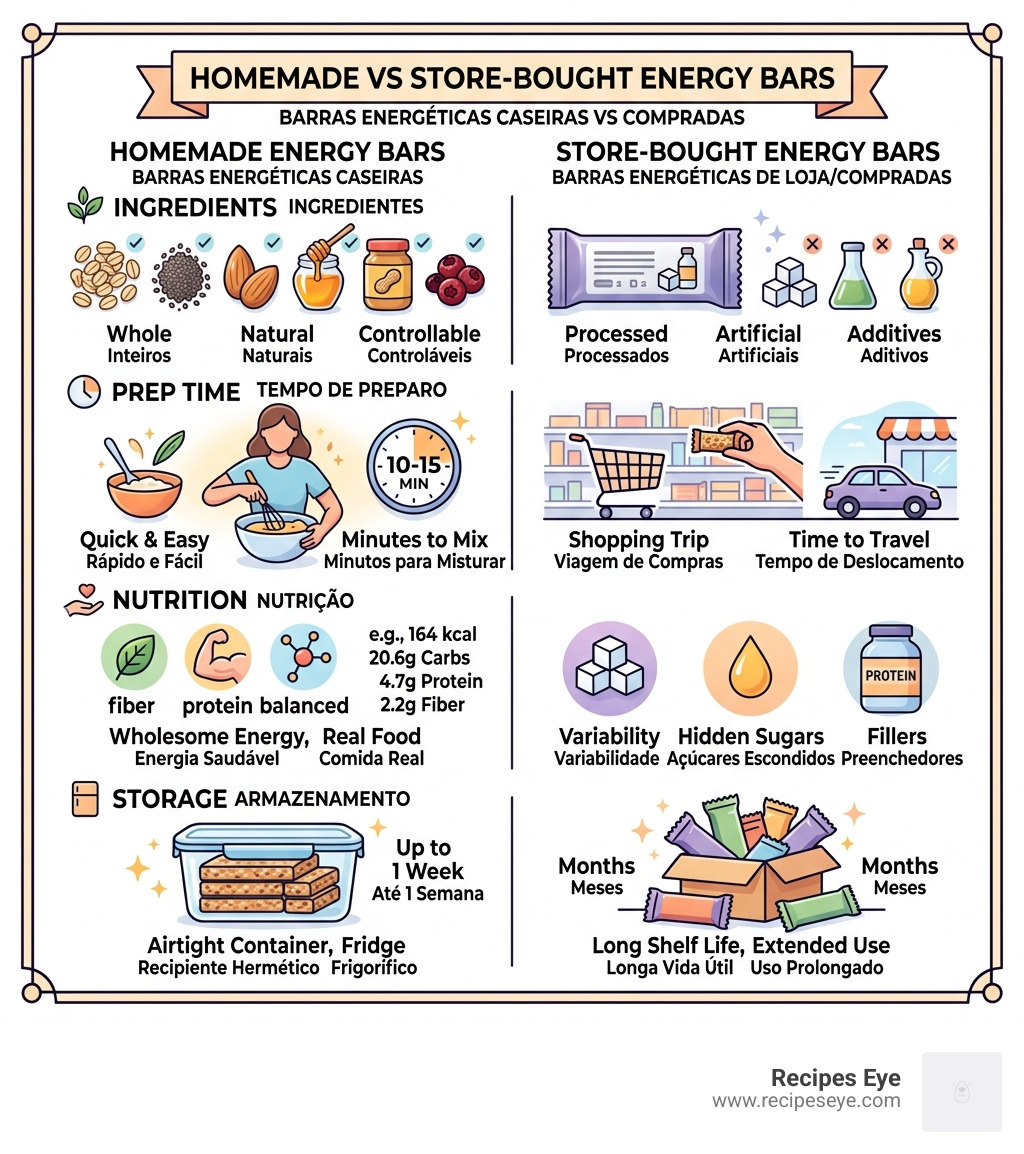
Advantages of Homemade Energy Bars
In our journey here at Recipes Eye, we’ve realized that the biggest barrier to healthy eating in 2026 is convenience. Often, we turn to what’s ready on the shelf. However, homemade energy bars offer benefits that industrial products simply cannot match.
The first major advantage is total ingredient control. When we make our own bars, we eliminate high fructose corn syrup, hydrogenated oils, and preservatives that extend the product’s shelf life but not our health. Additionally, the savings are significant; buying oats, seeds, and honey in bulk is much cheaper per serving than buying individual packaged bars.
| Feature | Homemade Bar | Store-bought Bar |
|---|---|---|
| Sugar | Natural (honey, dates, fruits) | Often refined or syrups |
| Preservatives | Zero | Present for durability |
| Cost | Low (bulk ingredients) | Medium to High |
| Customization | Total (adjust to your taste) | Fixed |
| Sodium | Just a pinch to enhance flavor | Often high |
If you are looking for a Quick and easy recipe for making homemade energy bars, know that simplicity is the secret to maintaining consistency in your routine.
Customization of Homemade Energy Bars
We love the fact that there is no “one-size-fits-all” rule for these bars. If you follow a vegan diet, you can easily substitute honey with agave syrup or molasses. For those avoiding gluten, just ensure the oats used are certified “gluten-free.”
Flavor variations are endless. You can create a tropical bar with coconut and dried mango, or something more comforting like apple and cinnamon. Using fruit pastes, such as date paste, works as an excellent natural binder that adds sweetness and fiber simultaneously.
Nutrition in Homemade Energy Bars
From a nutritional standpoint, homemade bars are true powerhouses. On average, a 35g to 40g bar provides about 164 kcal. But these aren’t empty calories. We are talking about:
- Carbohydrates (approx. 20.6g): From oats and dried fruits, ensuring gradual energy release.
- Proteins (approx. 4.7g): From nuts (almonds, walnuts) and seeds (chia, pumpkin).
- Good Fats (approx. 8.2g): Essential fatty acids that help with satiety.
- Fiber (approx. 2.2g): Crucial for digestive health.
This nutritional density makes them the perfect pair for the smoothies we share here, creating a complete snack that sustains you for hours.
Essential Ingredients and Creative Variations

To start your production of homemade energy bars, you need a solid base. Rolled oats are the queen here, providing the necessary structure. But what keeps it all together?
Binders can be “wet” like peanut butter, almond butter, or even a surprising ingredient: extra virgin olive oil. Some traditional recipes use olive oil to provide a silky texture and add heart-healthy monounsaturated fats.
For the “filling,” let your creativity flow:
- Seeds: Chia, sunflower, and pumpkin add crunch and minerals.
- Dried Fruits: Goji berries, raisins, cranberries, and apricots bring natural sweetness.
- Special Touch: Chopped dark chocolate (minimum 70% cocoa) or chips for those moments when the body craves something sweet.
Superfoods and Popular Flavors
In 2026, the trend is to elevate nutritional value with superfoods. Adding cooked or flaked quinoa brings a complete amino acid profile. Spirulina can be used in cocoa bars for a “boost” of chlorophyll and iron, although the flavor is strong and should be balanced with honey or dates.
Flavors like pomegranate and pistachio offer a sophisticated touch, while the classic combination of apricot and cashew nuts never fails. If you like light textures, puffed rice is an excellent addition, making the bar less dense and crunchier.
Interestingly, the search for homemade energy goes beyond the kitchen. Just as we seek nutritional autonomy, some explore total energy autonomy, as shown in this guide on How to Make a Simple Homemade Energy Generator: in 2026, showing that the concept of “homemade” and “sustainable” is stronger than ever in our lives.
Step-by-Step Guide: From Preparation to Oven
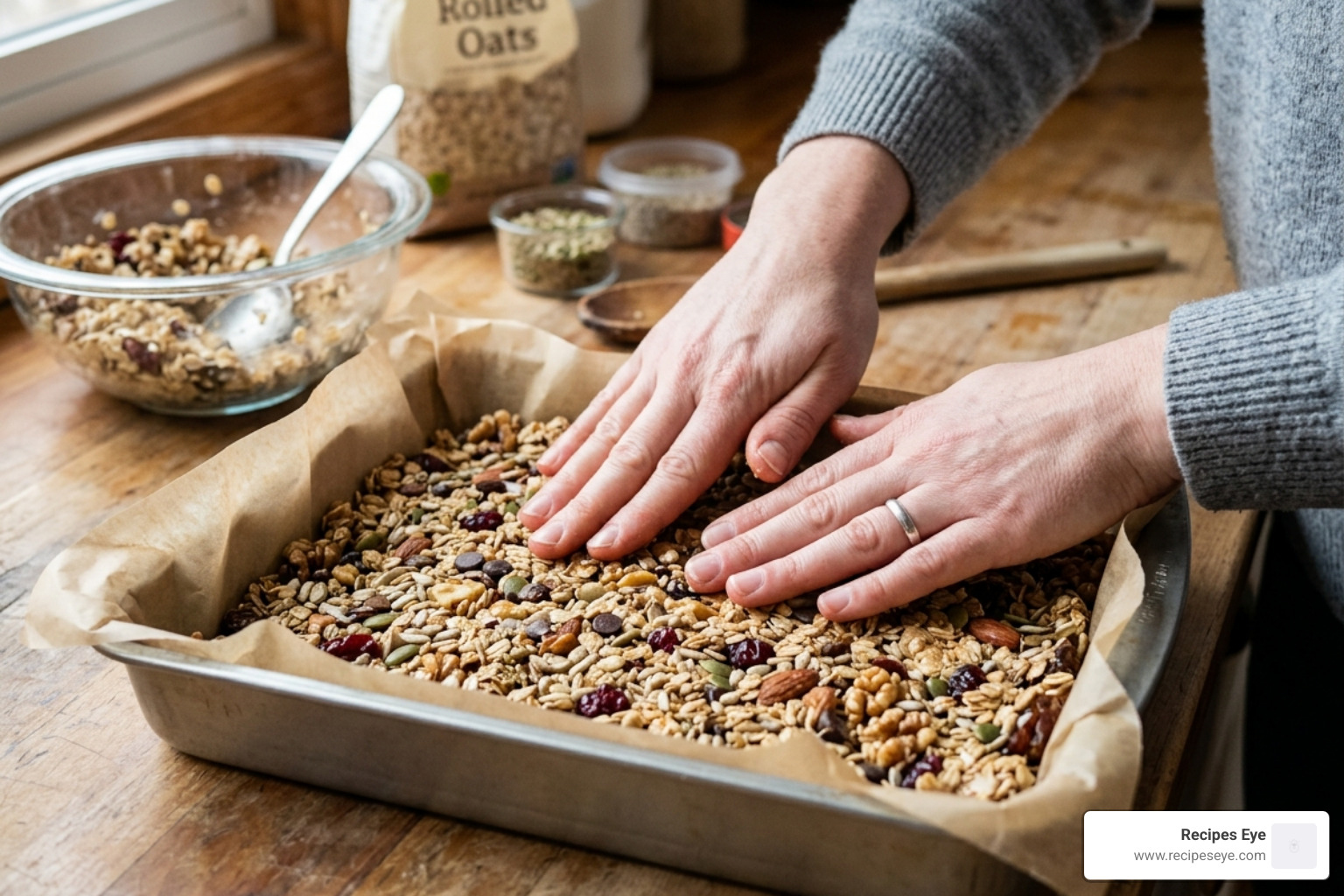
Making your homemade energy bars is an almost therapeutic process. Here is our favorite method to ensure they don’t break:
- Preparation: Start by lining a rectangular pan with parchment paper, leaving overhangs on the sides for easy removal.
- Mixing Dry Ingredients: In a food processor or large bowl, mix the oats, chopped nuts, and seeds. If using a processor, give just a few pulses to maintain texture.
- Liquid Binding: Gently heat the honey (or agave) with the peanut butter or olive oil until they become fluid. Add vanilla extract and a pinch of salt.
- Uniting: Pour the liquid over the dry ingredients and mix well until all the oat flakes are shiny and sticky.
- Pressing: This is the most important part. Transfer the mixture to the pan and, using a rolling pin or the bottom of a glass, press down very hard. The mixture must be compact, about 3 cm thick.
- Baking: Place in a preheated oven at 190°C for about 15 minutes (or until the edges are golden).
Necessary Equipment and Common Errors
You don’t need a professional kitchen. A sharp knife for the final cut and a metal or silicone pan are enough. However, avoid the common mistake of adding too much sweetener; this can make the bar too “chewy” or too soft.
Another critical error is trying to cut the bars while they are still hot. They need complete cooling (often a few hours in the refrigerator) for the structure to firm up. If you cut too early, you’ll have granola instead of bars!
Tips for Perfect Textures
- No-Bake Bars: If you prefer not to use the oven, use a larger base of processed dates. They act as a natural “glue.” After pressing, leave in the refrigerator for at least 2 hours.
- Digestibility: For those with sensitive digestion, soaking the nuts for a few hours before drying and using them in the recipe can help.
- Crunch: Puffed rice should be added last so it doesn’t wilt with the heat of the liquid ingredients.
- Finishing: Want a bakery-worthy snack? Dip half of the already cooled bar into melted dark chocolate. It’s the perfect balance between health and pleasure.
Storage and Preservation for Maximum Freshness
After all the effort, you want your homemade energy bars to last all week. Proper storage is the key to maintaining that wonderful “crunch” or soft texture.
The ideal way is to store them in an airtight container. At room temperature, they last well for about one week, provided the location is cool and dry. If you live in a very humid or hot region (common in certain times of 2026), refrigeration is mandatory to prevent the oils in the nuts from going rancid or the bar from losing its consistency.
How to Freeze and Thaw Correctly
Yes, you can (and should!) make them in large quantities and freeze them. To prevent them from sticking together, wrap each bar individually in a piece of parchment paper before placing them in a freezer bag (like a zip-lock).
- Freezer Duration: Up to one month without loss of flavor.
- Thawing: Simply remove from the freezer and leave at room temperature for about an hour. They recover their original texture perfectly. It’s the ultimate “meal prep” for those with busy mornings.
Frequently Asked Questions about Energy Snacks
How long do homemade bars last?
As we mentioned, the shelf life varies. At room temperature, 7 days is the standard. In the refrigerator, they can safely last up to 14 days. In the freezer, one month. Always remember to check the smell and texture; if they become excessively soft or have a strange odor, it’s time to discard them.
Can I substitute honey with another sweetener?
Absolutely! Brown rice syrup is a fantastic substitute because it is very sticky and helps with the structure. Agave is sweeter, so use a little less. For a no-added-sugar option, use a very concentrated date paste (dates soaked and blended with minimal water).
Why did my bars turn out crumbly?
Generally, this happens for two reasons: lack of binder (liquid/honey/butter) or lack of pressure when placing them in the pan. If your mixture seems too dry before going into the oven, add an extra tablespoon of water or honey. And don’t be afraid to use force when pressing!
Conclusion
At Recipes Eye, we believe that conscious nutrition is the foundation for lasting well-being. In 2026, with an increasingly routine, mastering the art of homemade energy bars is a superpower. They are practical, delicious, and, above all, respect your body.
We hope this guide inspires you to get into the kitchen and experiment with your own combinations. After all, there is nothing more satisfying than knowing exactly what fuels your energy.
Transform your routine with flavor and health!

