
How to Use the Google Flights App to Save Big
The Google Flights App: Your Shortcut to Cheaper Travel
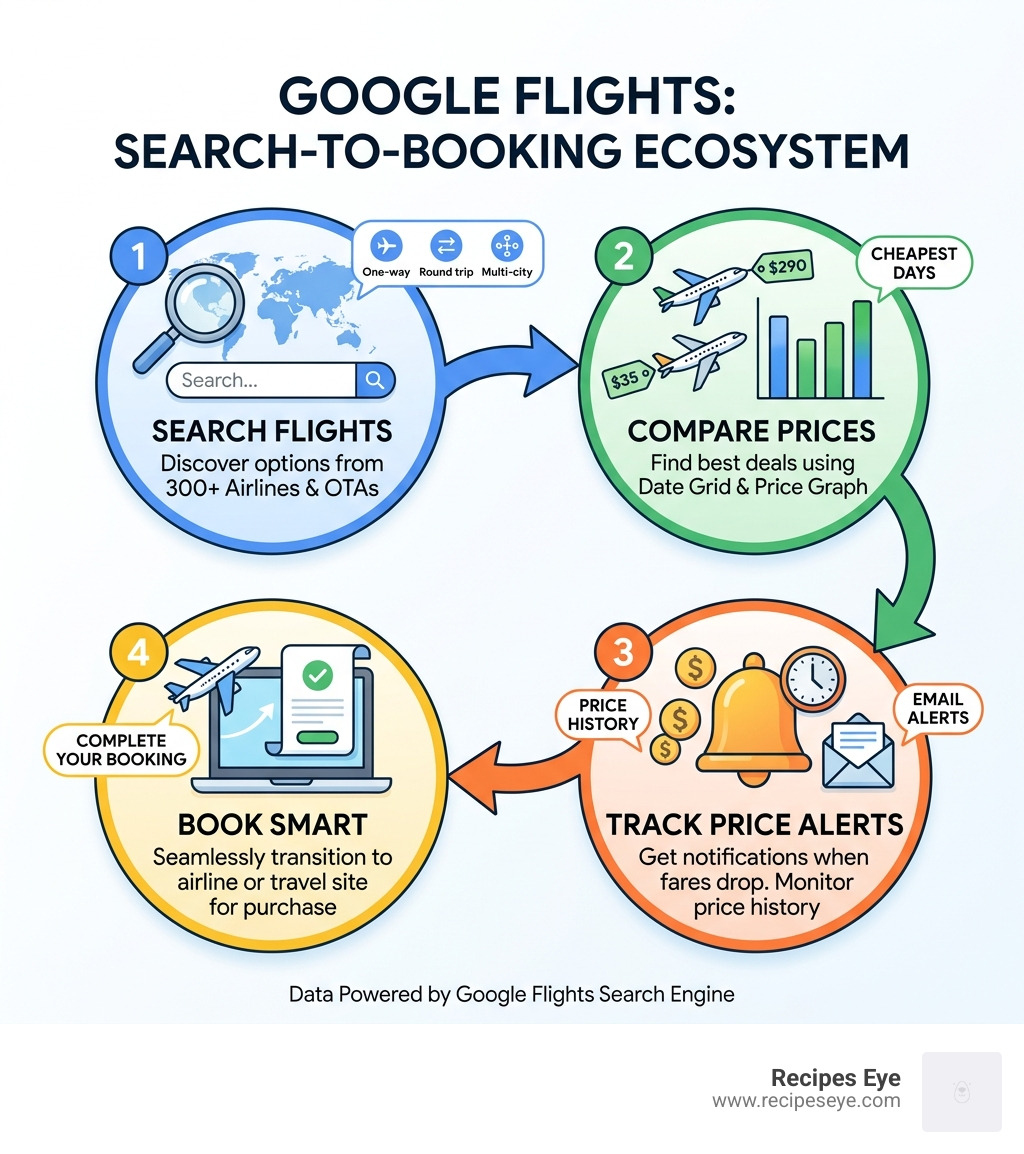
The google flights app is a free flight search tool from Google that helps travelers compare prices across hundreds of airlines and booking sites — all in one place.
Quick answer: What does the Google Flights app do?
- Searches flights from 300+ airline and OTA partners
- Shows price history so you know if a deal is actually good
- Lets you track prices and get email alerts when fares drop
- Offers an AI-powered “Flight Deals” tool for flexible travelers
- Displays flight amenities like legroom, Wi-Fi, and carbon emissions
- Helps you find the cheapest days to fly with a date grid and price graph
Important: Google Flights is a search engine, not a booking site. You compare flights on Google, then click through to the airline or travel agency to complete your purchase.
If you’re tired of overpaying for flights — or spending hours jumping between airline websites — Google Flights brings everything into one clean, fast interface. It’s constantly adding new features too, including an AI tool that lets you describe your dream trip in plain language and find matching deals automatically.
Whether you’re hunting for a last-minute weekend escape or planning an international trip months out, Google Flights gives you the data to book smarter and spend less.
How to Navigate the Google Flights App Interface
Navigating the google flights app interface is designed to be intuitive, but there are several hidden “pro” features that can save you a fortune if you know where to look. When you first open the Google Flights dashboard, you are greeted with a clean search bar where you can select your ticket type: one-way, round trip, or multi-city.
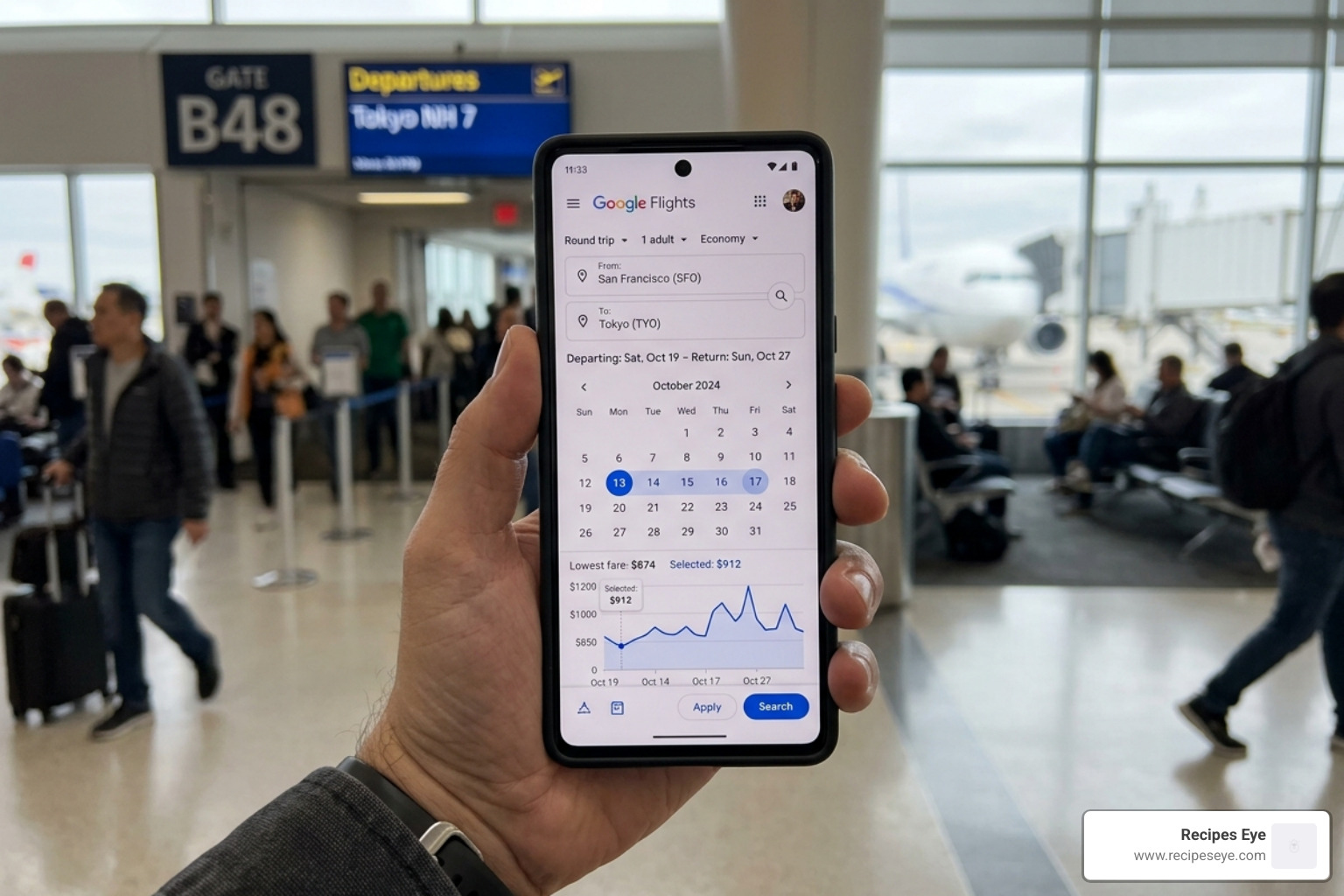
The real power lies in the flexibility of the inputs. Unlike traditional travel sites that lock you into one set of dates, this platform encourages exploration. You can enter your departure city and leave the destination as “Anywhere” to see a global map of prices. As of April 2026, the interface has become even more streamlined, allowing you to toggle between “Best” flights (which balance price with travel time) and “Cheapest” flights (which might involve longer layovers or self-transfers).
Searching Multiple Airports Simultaneously
One of our favorite tricks at Recipes Eye for saving on travel is the “Multiple Airport” search. You aren’t limited to just one departure or arrival point. By tapping the “+” icon or typing multiple airport codes (like JFK, LGA, and EWR for New York), the google flights app will aggregate every possible combination to find the lowest fare.
You can also perform a radius search. If you are willing to drive two hours to a different hub to save $300, simply add those regional airports to your search query. This is particularly useful for international travel, where flying into a major hub like London or Paris and taking a short regional flight can be significantly cheaper than flying directly to a smaller city.
Navigating the Date Grid and Price Graph
If your travel dates are even slightly flexible, the Date Grid and Price Graph are your best friends.
- The Date Grid: This tool shows you a matrix of departure and return dates. Often, moving your trip by just one day (for example, flying on a Tuesday instead of a Monday) can slash the price by 30% or more. The cheapest options are always highlighted in green, making them easy to spot.
- The Price Graph: This visual tool allows you to see price trends over a month or more. It’s perfect for answering the question, “When is the cheapest time this summer to visit Italy?” You can slide your finger across the bars to see how prices spike on weekends and drop during mid-week windows.
Leveraging AI for Personalized Flight Deals
As we move through 2026, artificial intelligence has completely transformed how we find bargains. The google flights app has introduced a AI conversational search interface that moves away from rigid drop-down menus and toward natural, human-like interaction.

This new “Flight Deals” tool is currently in beta and is available to users in the United States, Canada, and India. It is designed specifically for the “flexible seeker”—someone who knows they want a vacation but isn’t tied to a specific coordinate on a map.
Describing Your Ideal Trip with AI
Instead of typing “NYC to LON July 10,” you can now talk to the google flights app like a travel agent. You can enter nuanced requests such as:
- “Find me a 10-day ski trip this winter to a world-class resort with fresh powder.”
- “Show me week-long trips to cities with great food, nonstop flights only, under $500.”
The AI processes these natural language requests and cross-references them with real-time data from hundreds of airlines. It understands the “vibe” of your request, matching “great food” with destinations like Tokyo, Mexico City, or Lyon, and filtering for the best current bargains.
Discovering Hidden Destinations
The beauty of AI-driven search is its ability to suggest destinations you might never have considered. If you ask for a “tropical beach getaway in May,” the AI might find a massive price drop for a flight to the Azores or Albania’s coast—places that weren’t on your radar but offer exactly what you’re looking for at a fraction of the cost of Hawaii or the Maldives. This user-centric discovery ensures that your budget goes further by prioritizing the value of the deal over the brand name of the destination.
Advanced Filtering for Comfort and Savings
Finding a cheap flight is great, but finding a cheap flight that doesn’t make you miserable is better. The google flights app offers some of the most robust filtering tools in the industry to ensure your “deal” doesn’t come with hidden headaches.
You can filter by:
- Airlines and Alliances: If you are loyal to Delta (SkyTeam) or United (Star Alliance) to rack up points, you can hide all other results.
- Connecting Airports: Avoid notoriously difficult connection hubs or ensure you have a layover in a city where you’d actually like to grab a coffee.
- Bags: You can specify if you’re bringing a carry-on or checked bag so the prices shown include those fees upfront.
Can I exclude basic economy in the google flights app?
Yes! This was a major update that travelers have been begging for. Basic Economy fares often come with “gotchas” like no overhead bin access or no seat selection. In the fare class tab, you can now select “Economy (exclude basic)”. This allows you to compare “real” prices—tickets that actually include the amenities you need—rather than being baited by a low price that doubles once you add a bag and a seat.
Evaluating Amenities and Emissions
Google has integrated “Flight Insights” directly into the search results. Before you click “Book,” you can see:
- Legroom: Is it the standard 30-31 inches, or are you looking at a cramped 28 inches on a budget carrier?
- Wi-Fi and Power: See if the plane is equipped with outlets and internet so you can stay productive (or entertained).
- Carbon Footprint: In 2026, sustainability is a priority. The google flights app shows you the CO2 emissions for every flight. For example, you might see that a flight on a Boeing 787 Dreamliner emits significantly less CO2 than an older Boeing 777 on the same route. Choosing the “green leaf” option often means flying on newer, more comfortable aircraft.
| Feature | “Best” Flight Result | “Cheapest” Flight Result |
|---|---|---|
| Price | Competitive | Absolute Lowest |
| Duration | Usually Nonstop or Short Layover | Can be very long |
| Convenience | High (Good times/airports) | Variable |
| Stops | 0 to 1 | Often 2+ |
Strategic Booking and Price Tracking
Timing is everything in the travel world. The google flights app provides historical data to tell you if the current price is “low,” “typical,” or “high” based on the last 12 months of data for that specific route.
For domestic flights, the “sweet spot” for booking is usually 1 to 3 months in advance. For international trips, we recommend looking 3 to 6 months out. However, don’t just guess—use the Explore tool to see the broader trends.
How do I track prices on the google flights app?
If you aren’t ready to pull the trigger yet, use the Track Prices toggle. You can track:
- Specific Dates: If you must travel for a wedding on June 12th.
- Any Dates: If you just want to go to Tokyo sometime this year and want to wait for a massive price drop.
Once enabled, Google will send you email notifications the moment the price changes. This is the ultimate “set it and forget it” strategy for saving money.
Booking Directly vs Third-Party OTAs
Google Flights partners with over 300 airlines and online travel agencies (OTAs). When you find a flight, you’ll see a list of booking options.
- Booking Directly: We generally recommend booking directly with the airline. It makes it much easier to handle changes, cancellations, or refunds (especially with the US 24-hour refund policy).
- Separate Tickets: Sometimes Google will suggest “separate tickets” (e.g., flying out on JetBlue and back on United) to save money. Be careful! If these are “self-transfer” tickets, the airlines aren’t responsible if a delay on the first flight causes you to miss the second. Always ensure you have a long layover if you choose this path.
Frequently Asked Questions about the Google Flights App
Is the AI Flight Deals tool available in my country?
Currently, the AI-powered Flight Deals tool is in beta and available in the U.S., Canada, and India. Google plans to roll this out to more regions throughout 2026 and 2027. If you are outside these regions, you can still use the standard “Explore” map to find incredible deals.
How does Google Flights calculate carbon emissions?
Google uses the Travel Impact Model (TIM), which considers the aircraft type, flight distance, and even the number of seats in each class. Higher-density planes (more seats) generally have lower emissions per passenger.
Why are some airlines missing from the results?
For an airline to appear, they must have a partnership with Google. While most major carriers (over 300) are included, some “ultra-low-cost” carriers or specific regional airlines might opt out. If you don’t see a specific airline you know flies a route, it’s always worth a quick check on their direct website.
Conclusion
Mastering the google flights app is the single best thing you can do for your travel budget in 2026. By combining the power of AI-driven searches with the data-heavy Date Grids and Price Tracking, you can stop guessing and start booking with confidence.
At Recipes Eye, we know that travel is about more than just the destination—it’s about the experiences you have along the way. And since long travel days can be draining, don’t forget to pack some of our healthy travel recipes to keep your energy up! Whether it’s nutritious snacks for a long-haul flight or a quick meal to prep in your vacation rental, we’ve got you covered. Happy travels and even happier savings!

