
Portuguese Conventual Sweets That Crossed Centuries to Your Table
Portuguese conventual sweets are traditional desserts created in convents and monasteries in Portugal, with over 500 years of history. Here is the essential info:
- What they are: Sweets made mainly with egg yolks, sugar, and almonds, born inside Portuguese convents and monasteries
- Origins: Date back to the 15th century, when sugar from Madeira and Brazil replaced honey in monastic recipes
- Why so many yolks: Nuns used egg whites to starch habits and clarify wines, leaving a huge surplus of yolks
- How many exist: More than 150 varieties spread across the country, each with its own regional identity
- The most famous: Pastel de Nata, Toucinho do Céu, Ovos Moles de Aveiro, Barriga de Freira, Pudim Abade de Priscos
- Where to taste: From Lisbon to the Algarve, from the Azores to Madeira — each region has its own
There is a Portuguese expression that perfectly describes these sweets: “para comer rezando” (to eat while praying). In other words, so good they seem divine.
And it’s no coincidence that the word “divine” appears here. These sweets were indeed born inside monasteries and convents. They were created by nuns and monks who had an enviable problem: too many egg yolks and sugar in abundance.
The result? One of the richest and most original confectionery traditions in the world.
For centuries, these recipes were kept as sacred secrets, passed only within the convent walls. When the Portuguese government abolished religious orders in 1834, many of these recipes risked disappearing forever. Some were lost. But others survived — and today they are part of Portugal’s gastronomic identity.
In this guide, you will discover the history behind these sweets, their regional origins, the techniques that make them unique, and how you can recreate them at home.
What are Conventual Sweets and Their Divine Origin
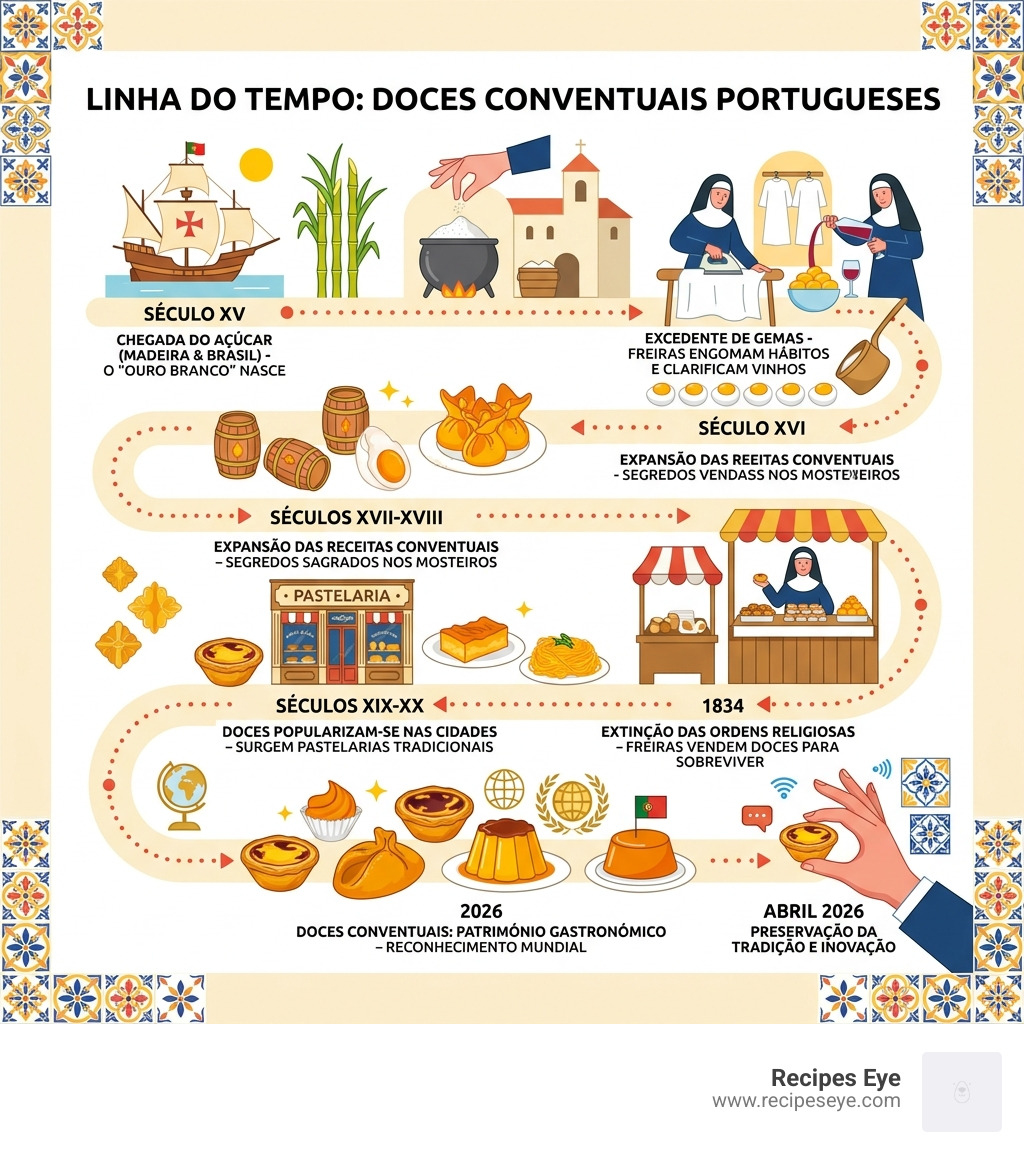
To understand what defines Portuguese conventual sweets, we need to travel back in time. Imagine Portugal before the 15th century. At that time, confectionery was based almost exclusively on honey and dried fruits, a heritage left by the Arabs who inhabited the Iberian Peninsula. However, everything changed with maritime expansion.
With the arrival of the Portuguese in Madeira Island and, later, in Brazil, cane sugar became a central product in the kingdom’s economy. What was once a rare luxury, sold in grams in apothecaries (pharmacies), began to arrive at Portuguese ports in large quantities. Convents and monasteries, which often received royal endowments or donations in kind, found themselves supplied with this new “white gold.”
But why so many eggs? This is the question we all ask when seeing a display case full of vibrant yellow sweets. The answer is purely practical and economic. Between the 18th and 19th centuries, Portugal was the largest producer of eggs in Europe. In convents, egg whites were used in industrial quantities for two main functions:
- Starching clothes: Nuns and monks used the whites to leave their habits and vestments impeccably white and rigid.
- Clarification of wines: In wine production, the whites served to filter impurities from the wine, a process still used today in some traditional cellars.
As a result, the convents were left with mountains of egg yolks which, so as not to be wasted (which would be a sin!), were mixed with the abundant sugar. Thus was born Conventual confectionery, an art that transformed necessity into pure indulgence.
The 1834 Revolution and the Survival of Secret Recipes
The year 1834 marks a dramatic turning point in the history of Portugal. With the victory of the liberals and the subsequent extinction of religious orders, all male convents and monasteries were closed, and female ones were prevented from accepting new novices, awaiting their gradual extinction.
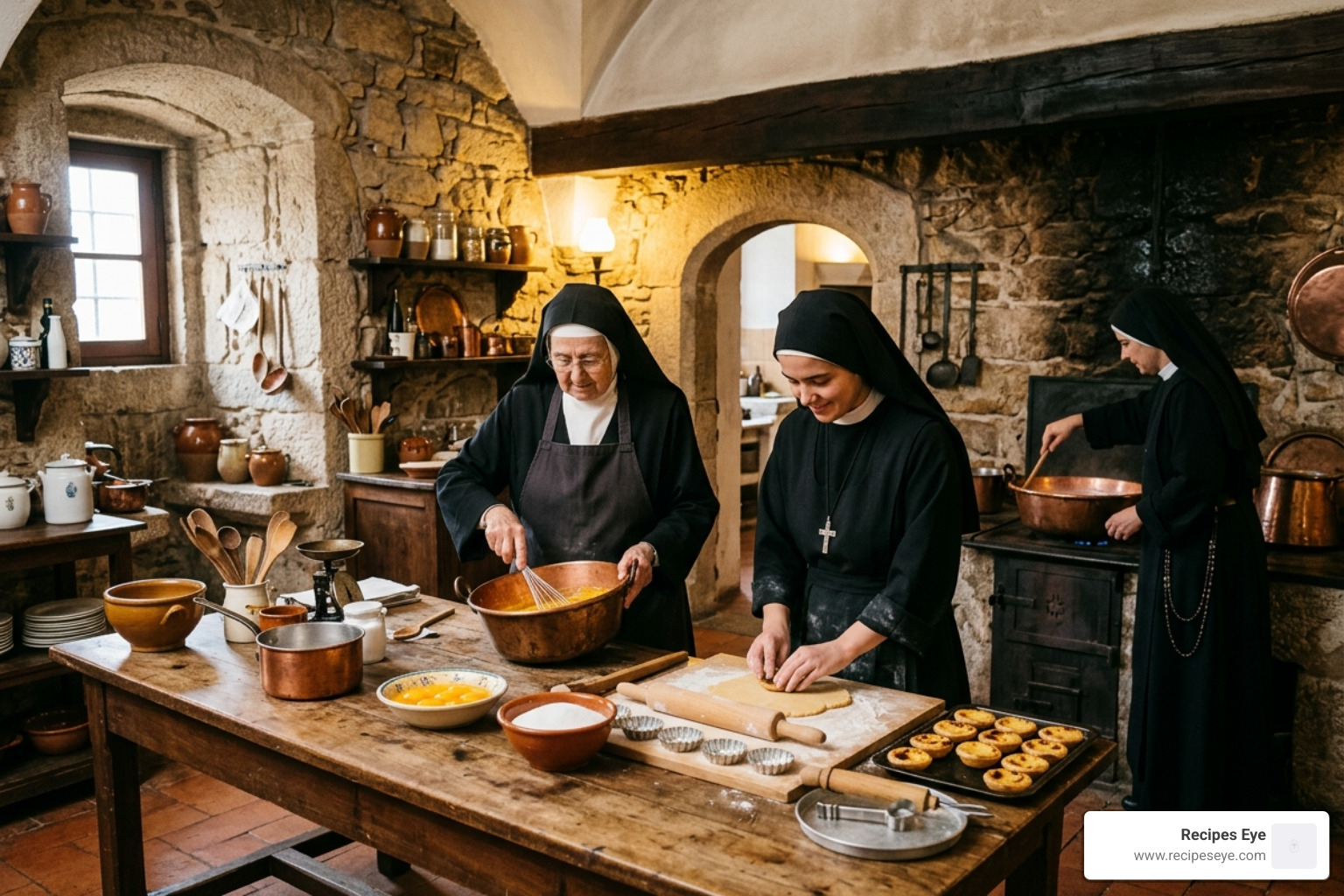
This event could have been the end of Portuguese conventual sweets. Without the protection of the orders, monks and nuns suddenly found themselves without means of subsistence. The solution for survival was, literally, sweet: they began to sell their secret recipes to the public or produce the sweets for direct sale.
The most emblematic case of this transition is that of the Pastel de Belém. The Pastel de Belém is a tradition that was born in Portuguese monasteries, specifically in the Jerónimos Monastery. After the monastery closed, one of its former occupants began selling these pastries in a nearby sugar refinery. In 1837, the official factory opened, which to this day keeps the original recipe under lock and key in the “Secret Workshop.”
Thanks to this need for survival, recipes that were once exclusive to spiritual recluses passed into the hands of local families and professional confectioners. In 2026, we still celebrate this resilience every time we enter a traditional pastry shop and order a sweet that, technically, should have disappeared almost two centuries ago.
Regional Guide: Where to Find the Best Portuguese Conventual Sweets
Portugal is a small country in territory but a giant in gastronomic diversity. Each region adapted the base of “sugar and yolks” to the ingredients it had on hand, such as almonds in the Algarve or chestnuts in the interior.
To help with your next gastronomic trip, we have prepared a comparative table of the heavyweights of conventual confectionery:
| Sweet | Region of Origin | Key Ingredients | Characteristic Texture |
|---|---|---|---|
| Ovos Moles | Aveiro | Yolks, sugar, wafer | Creamy inside, crisp outside |
| Pudim Abade de Priscos | Braga | Yolks, sugar, bacon, Port wine | Silky and dense, melts in the mouth |
| Pastel de Tentúgal | Coimbra | Yolks, sugar, ultra-thin puff pastry | Crunchy and light |
| Toucinho do Céu | Trás-os-Montes/Alentejo | Yolks, sugar, almond, gila | Moist and grainy |
| Barriga de Freira | Minho/Viseu | Yolks, sugar, bread or almond | Sweet and rich paste |
One of the most fascinating examples of preservation is what we find in Traditional Portuguese Products — Delícias do Convento. This sweet, originating from Lourinhã, uses Algarve almonds with skin, which gives it a unique dark color, differentiating it from most conventual sweets that tend toward bright yellow.
Portuguese Conventual Sweets from North to South
In the North, Minho stands out with Pudim Abade de Priscos, a 19th-century creation that challenges the senses by including pork bacon in the recipe — the secret to its unparalleled texture. In Amarante, Papos de Anjo and Brisas do Tâmega are mandatory stops.
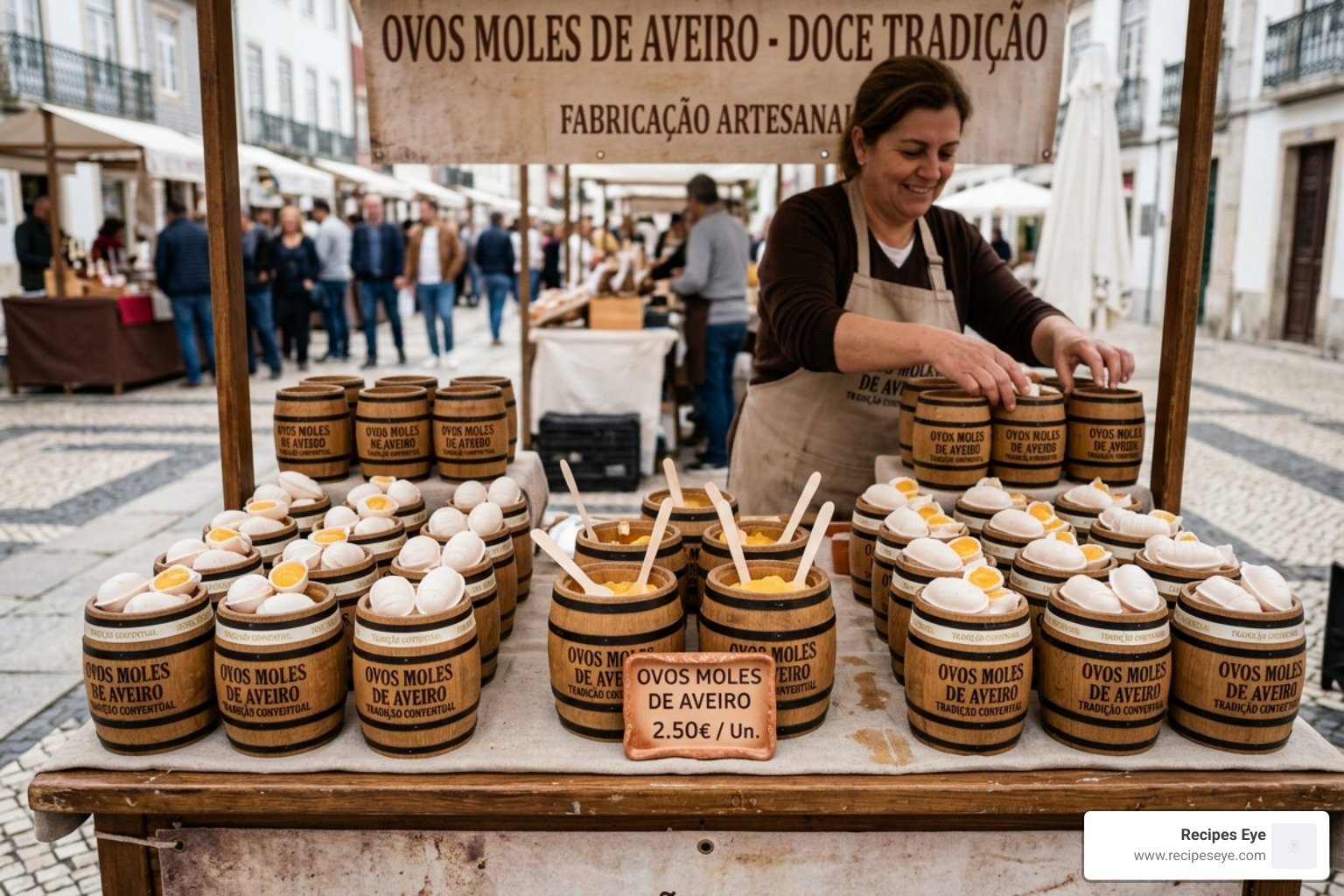
In the Center, Coimbra and its surroundings are the heart of confectionery. In addition to the Pastel de Tentúgal, we have Arrufadas and Manjar Branco from Portalegre. In Aveiro, Ovos Moles have Protected Geographical Indication (PGI), which ensures that only those produced in the region following the traditional method can bear this name.
In the Alentejo, the region’s heat seems to be reflected in the richness of the sweets. The Encharcada de Évora, served in deep plates and loaded with syrup, and the Sericaia (which some say has Indian origins brought via Elvas) are monuments to sugar.
In the Algarve, Arab influence merges with the conventual. The Dom Rodrigo, wrapped in egg threads and colored silver paper, uses the Algarve almond as the protagonist. In the Islands, Madeira is proud of its Honey Cake (which uses cane molasses instead of refined sugar) and the Azores delight us with Queijadas from Vila Franca do Campo.
The Legacy of Portuguese Conventual Sweets in Lisbon
Lisbon acts as a great meeting point for all these traditions. If you don’t have time to travel the country, the capital offers high-quality confectionery “embassies.”
Pastelaria Alcôa, originally from Alcobaça, brought some of the country’s best examples of Cornucópias and Puddings to Rua Garrett. Casa dos Ovos Moles transports Aveiro to the heart of Lisbon, while Confeitaria Nacional, founded in 1829, maintains the perfect period atmosphere to taste a King Cake or a slice of Toucinho do Céu.
Of course, no visit is complete without going to Belém. But the impact of these sweets goes beyond tourism; they are a fundamental part of cultural identity. In 2026, the Portuguese conventual sweet continues to be the center of family celebrations, baptisms, and weddings, proving that the monastic tradition is very much alive in the urban palate.
Confectionery Techniques: The Secret of Yolks and Sugar
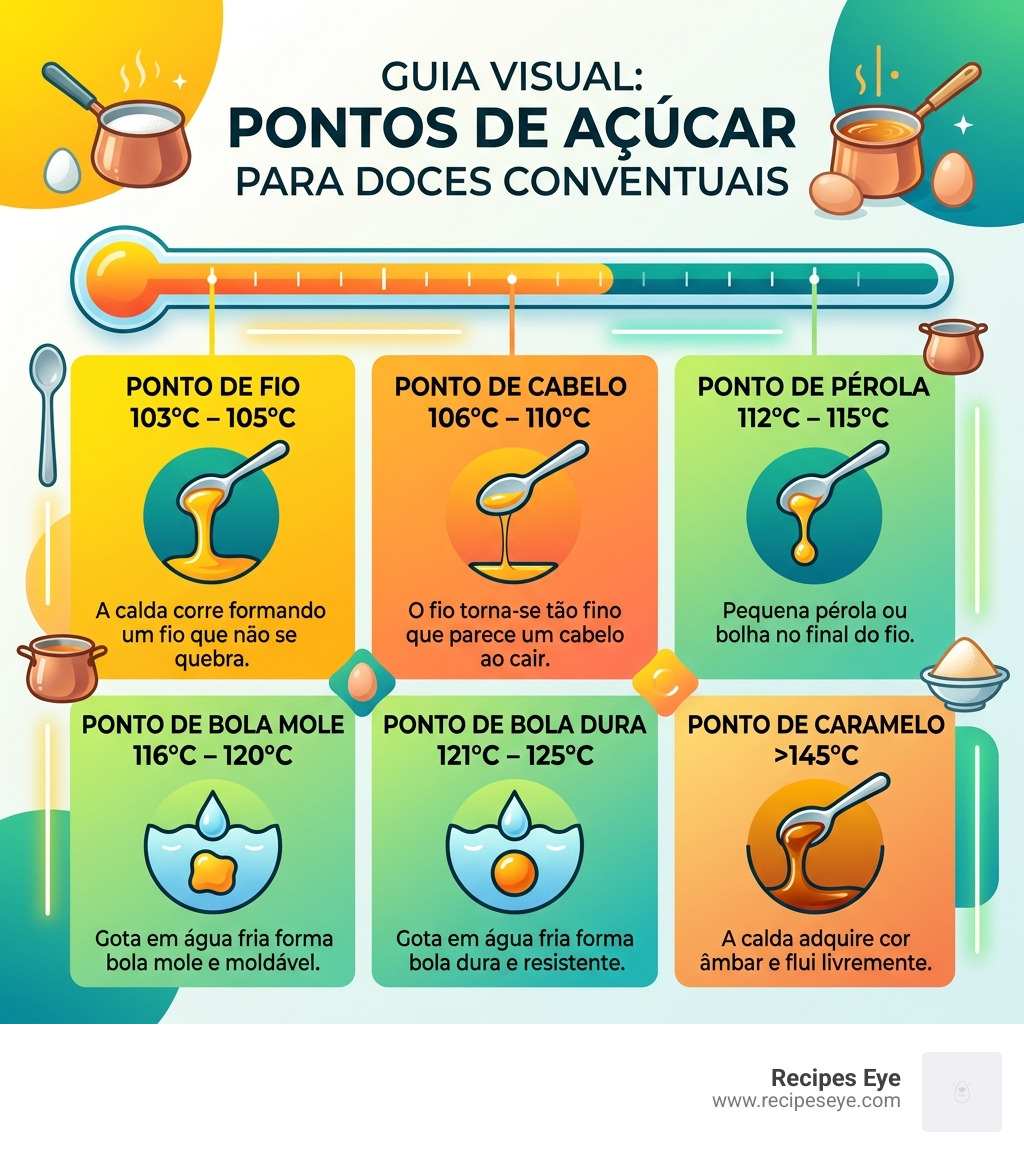
Making Portuguese conventual sweets is not just about mixing ingredients; it is a science of precision that requires patience and technique. The secret lies in mastering the sugar points.
Unlike modern pastry that uses exact weights, traditional Portuguese confectionery is based on the temperature and behavior of the sugar syrup. There are at least eight well-known points, ranging between 103ºC and 125ºC:
- Thread Point: The syrup runs from the spoon forming a thread that doesn’t break.
- Hair Point: When the thread becomes so thin it looks like a hair as it falls.
- Ball Point (Soft and Hard): When a drop of syrup dipped in cold water forms a small ball.
Another secret is the treatment of the yolks. To obtain that brilliant color and avoid the smell of egg, the yolks must be passed through a fine mesh strainer (sifted) to remove the membrane that surrounds them. Additionally, the use of copper pots is traditionally recommended for distributing heat evenly, essential for not “burning” the yolks when mixing them with the hot syrup.
How to Prepare Portuguese Conventual Sweets at Home
We at Recipes Eye believe that tradition can be brought into the modern kitchen with success. If you want to try a homemade version, Toucinho do Céu is an excellent starting point as it is relatively simple and does not require complex puff pastry techniques.
Tips for success:
- Egg Quality: Use eggs from free-range chickens. The yolk color is much more intense and the flavor richer.
- Fresh Almonds: If you can, grind the almonds at the time. The natural fat of the nut makes all the difference in the moisture of the sweet.
- Syrup Temperature: Never add the yolks to the boiling sugar syrup. Let the syrup cool slightly so as not to “cook” the eggs instantly, creating lumps.
Frequently Asked Questions about Doces Conventuais
Why do conventual sweets use so many egg yolks?
As we explained, this is due to the historical surplus of yolks in convents. Since egg whites were used to starch clothes and clarify wine, yolks became the main ingredient to avoid waste. Over time, this abundance allowed for the development of incredibly rich and caloric recipes that are today the hallmark of Portugal.
What is the real difference between Pastel de Nata and Pastel de Belém?
The difference is, above all, legal and recipe-based. The name “Pastel de Belém” is a patented trademark and its recipe is a secret kept by the Fábrica dos Pastéis de Belém in Lisbon. All other similar pastries produced in Portugal or the world are called “Pastéis de Nata.” Although they use similar ingredients (milk, eggs, sugar, and puff pastry), the baking times and proportions vary significantly.
How to adapt these traditional recipes for a modern diet?
We know that Portuguese conventual sweets are sugar bombs. For a more balanced version, we suggest slightly reducing the amount of sugar (although this changes the traditional texture) or replacing part of the sugar with alternatives like erythritol in homemade recipes. Another tip is to focus on quality: eat a smaller portion, but of a sweet made with organic ingredients and high-quality eggs. The pleasure will be greater and the health impact smaller!
Conclusion
Portuguese conventual sweets are much more than simple desserts; they are time capsules that preserve the history, economy, and creativity of a people. From the silent kitchens of 15th-century monasteries to the vibrant pastry shops of April 2026, these recipes have proven to be immortal.
Preserving this culture is also a form of gastronomic tourism. By tasting an Ovos Mole in Aveiro or a Pastel de Tentúgal in Coimbra, you are supporting local producers and ensuring that these artisanal techniques are not lost in the era of industrial production.
At Recipes Eye, our mission is to discover and share these wonders, adapting them whenever possible to a conscious lifestyle, but without ever losing respect for tradition. After all, life is made of balances, and a “sugar sin” once in a while is essential for the soul.
Discover more incredible recipes on our portal and let yourself be inspired by the richness of Portuguese gastronomy!

